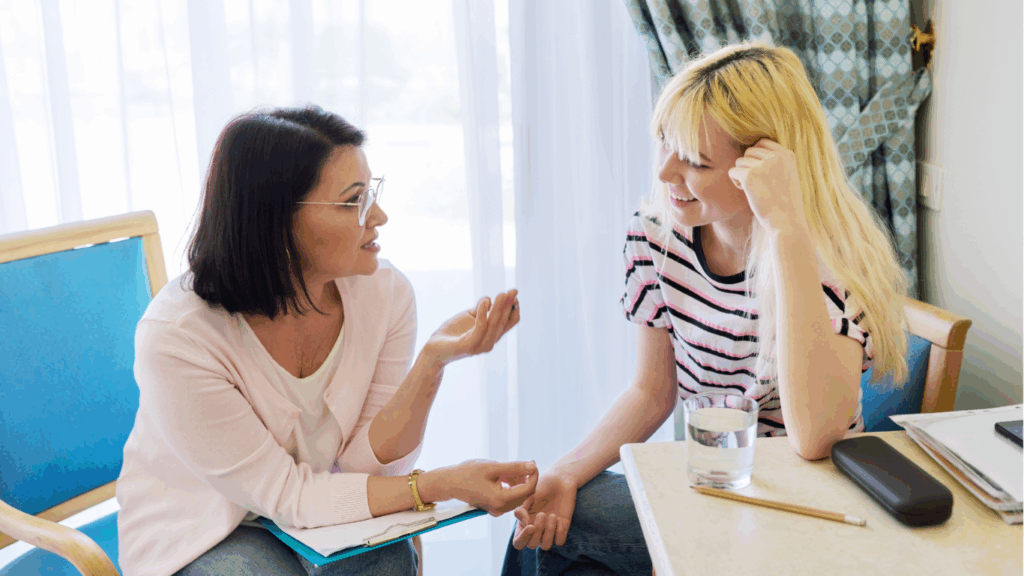
Johanna Simmons is a Registered Clinical Counsellor, Registered Play Therapist, educator, and adoptive parent. She works with children and families and supports them using a neuro-informedTM approach. In this Q&A, she explains how the nervous system shapes children’s behaviour, why co-regulation matters, and simple ways permanency caregivers can support both their child and themselves during big feelings.
Many parents think of behaviour as something to manage. What does it mean to see behaviour as communication from the nervous system instead?
All behaviour is communication. Children often don’t have the words to explain what they’re feeling, so they show it through their behaviour. Our job as parents is to try to understand the message behind that behaviour.
One way to do that is by attuning to our own nervous system. Our nervous system picks up what’s happening in our child’s nervous system. If we notice what’s going on in our body, it can give us clues about what the child is feeling.
For instance, if a child is struggling with a math problem, throws their paper, and starts screaming, our first reaction might be to jump in and react. But instead, we can pause and notice what’s happening in us. Maybe we feel tension in our chest or fists. Maybe we feel frustration. That gives us a clue that the child is feeling frustrated too.
Their behaviour isn’t misbehaviour. It’s a reflex of what’s happening in their nervous system. It’s their nervous system trying to discharge energy. The child isn’t being “bad.” They’re overwhelmed.
Adopted children often experience early stress, loss, or disrupted attachment. How can these experiences affect their nervous system and behaviour at home?
The disconnection from their birth mom is traumatic for a child. It puts their nervous system into a state of high alert. They don’t feel safe.
So when that child comes to us, their nervous system may already be elevated. If we imagine a scale from one to ten, where ten is completely dysregulated, that child might arrive at a six, seven, or even eight. That means it takes very little for them to become fully dysregulated and move into a fight, flight, or collapse response.
As adoptive parents, our job is to stay as regulated as we can, even in the middle of the child’s dysregulation. When we stay connected to ourselves, we can help co-regulate the child’s nervous system, because they don’t yet have the ability to regulate themselves.
What does co-regulation look like in everyday life, especially during meltdowns or aggression?
When a child is dysregulated, their nervous system is trying to discharge energy. We don’t want to interrupt that process, but we do want to help them feel safe.
At that moment, talking usually doesn’t help. The prefrontal cortex is offline. The child is in the reptilian brain. They’re in a fight, flight, or collapse response, and they can’t really hear us.
The best thing we can do is stay connected in whatever way we can and help create safety for that child. Dysregulation and tantrums can be very scary for children. They feel out of control and don’t know how to bring themselves back, so we have to help them as parents.
Some children will accept gentle touch. If so, that can be very regulating. If not, we can simply sit nearby, breathe, or rock gently. We might squeeze our own arms or ground ourselves in our body.
Our nervous system will be picked up by the child’s mirror neuron system. As we regulate, they begin to regulate too. It’s about modelling, not telling your child what to do.
If the child is being aggressive, we need to keep everyone safe. For example, if a child wants to hit, we might offer a pillow and say, “You can hit this.” The child has hitting energy, and it needs to come out. We’re just redirecting it in a safer way.
It also helps to build regulating activities into the day, not just during crises. That might look like dancing to music, playing what I call the “burrito game,” where a child is rolled up snugly in a blanket, or having the child push against your hands while you’re at eye level. You can also give them something heavy to push. All of these activities engage different muscles and help support regulation. These activities help keep the nervous system more regulated throughout the day.
How can parents support their own nervous system while caring for children with big needs?
This is hard. It’s easy to give advice, but in the moment, you’re stuck with reality, right?
As much as possible, try to plan extra time for transitions, getting ready for school, leaving the house, or heading to appointments. It can also help to involve the child in the process. Instead of saying, “Put your coat on,” you might ask, “What do you need to do before we leave?” That helps keep them connected to their thinking brain.
For ourselves, as much as we can, pause, notice our breath, and feel our feet on the floor. Even a few seconds can help us reconnect.
We’re not going to do this perfectly. We’ll lose our patience. We’ll yell sometimes. And that’s okay. What matters most is repairing the relationship. Going back later and saying, “I’m sorry I yelled. I wish I had taken a breath and asked if you needed help.” That rupture and repair actually builds stronger attachment than getting it right all the time. But we also have to be true to our words. The next time something similar happens, we try to pause, take a breath, and respond in the way we said we would.
And we need to care for ourselves, too. It’s like the oxygen mask on an airplane: you have to put yours on first. Parenting is one of the hardest jobs, and we often put ourselves last, but we can only show up for our children if we’re taking care of ourselves as well.
How can parents tell the difference between a dysregulated child and one who is being defiant?
A defiant or non-compliant child is a dysregulated child.
All behaviour, no matter how socially unacceptable, is an expression of the nervous system. It’s an attempt to regulate. When energy builds up in the system, it needs to be released, and that can come out through the hands, the legs, or the voice.
If we start to see behaviour this way, we shift from thinking, “This child is being difficult,” to “This child needs help regulating.”
Can you explain the difference between being calm and being regulated?
This is one of my biggest pet peeves. People often say “calm” when they really mean “regulated,” and they’re not the same.
Calm means there’s very little activation in the nervous system, like in deep meditation or lying in shavasana in yoga.
Regulated means there is activation, but you’re still connected to yourself. You can feel stress or strong emotion without going into fight, flight, or collapse.
When your child is activated, your nervous system will activate too. That’s normal. Regulation means you can stay connected to yourself and still connect with your child.
If you could offer parents one key mindset shift, what would it be?
Pause. And take a breath, so that you can respond rather than react.
If you still feel overwhelmed, pause again and take another breath. That simple shift can start to change your interactions with your child.
Tell us about your new book, Parenting in the 21st Century: The Neuro-Informed™ Parent. What inspired you to write it, and how do you hope it supports families?
This book has been about 15 years in the making. I used to facilitate parenting groups, and I always wanted to write a book, but something was missing.
Through my training, I learned more about the nervous system and how it shapes behaviour and relationships. That was the missing piece. A couple of years ago, I was finally able to put it all together.
My hope is that the book helps parents understand not just child development, but brain and nervous system development. When we understand what’s happening inside the child, we can see behaviour differently, not as defiance or manipulation, but as a reflexive reaction.
Looking back, how might this knowledge have helped when you were raising your own children?
Intuitively, I knew that the attachment rupture affected my daughters. I didn’t have the language or the science for it then, but I could see the impact.
I wish I had known more about co-regulation. I think it would have helped both me and my children develop better ways of coping during times of distress.
The good news is that the brain and nervous system are very malleable. They can be repaired. It’s never too late to do things differently. Even now, with my daughters as adults, our interactions have changed because of what I’ve learned.
You can learn more about Johanna at www.simmonscounselling.ca.