Belonging Network

Annual Impact Report 2025-26

5,300+
families, children and youth served during the 2025–26 fiscal year
49
years of helping families and youth thrive
9,000+
registered users on AgedOut.com

Belonging for all

This year, we reached 5,300 families, caregivers, and youth across BC through our programs and services.

We’re working for a world where every child and youth has the love, stability, and support they need to reach their fullest potential.

Because every child and youth deserves a place to belong. 

We help connect children and youth with permanent families. We prepare and support adoptive, kinship, and other permanency families before, during, and after placement. We help young people in and from government care build the knowledge, skills, and confidence they need as they enter adulthood.

Message from Chris and Anne | Why this work matters | Our role | Supporting adoptive, kinship, and permanency familiesSupporting youth in and from care | Family finding and permanency support | Indigenous relations | Stories from our community | Financials

Dear friends,

If our fiscal year 2025–26 had a theme, it would be adaptation—to big changes in the child welfare system and to a changing economic and funding climate that is impacting all nonprofits. Thankfully, Belonging Network has demonstrated a demonstrated record of agility, creativity and resilience in navigating change—just like the families and youth we serve.

In this year, we helped thousands of adoptive and permanency families thrive through every stage of their journey, while updating and creating resources for the growing number of kinship families coming to us for education, support, and connection. 

If our fiscal year 2025–26 had a theme, it would be adaptation—to big changes in the child welfare system and to a changing economic and funding climate that is impacting all nonprofits. Thankfully, Belonging Network has demonstrated a demonstrated record of agility, creativity and resilience in navigating change—just like the families and youth we serve.

In this year, we helped thousands of adoptive and permanency families thrive through every stage of their journey, while updating and creating resources for the growing number of kinship families coming to us for education, support, and connection. 

We added 48 new resource pages to BelongingNetwork.com, including a Kinship Care Toolkit. We launched an Introduction to Adoption & Permanency on-demand course, a prerequisite to our new 10-week facilitated course Learning for Everyone in Adoption and Permanency (LEAP), which now better reflects the needs of Indigenous and kinship participants. During November’s Adoption and Permanency Awareness month, we hosted a Financial & Legal Literacy Workshop for Kinship Caregivers in partnership with Fairness for Children Raised by Relatives. Our Facebook groups provided trusted peer support to over 1,180 members, including our newest group for Relatives raising Relatives. Our March outreach campaign to kinship caregivers resulted in over 7,000 page views, signalling increased awareness of all we have to offer this audience.

We also helped thousands of youth make a successful transition from government care to adulthood. We attracted over 500 new users to our AgedOut.com website, which is now approaching 10,000 registered users. In response to what has been called a national epidemic of gender-based violence (GBV) we added significant new GBV resources to empower youth from care to protect themselves and build healthy relationships.

We awarded $100,000 in bursaries to youth from care to support them in pursuing postsecondary education. We also entered an exciting 10-year, $1 million, partnership with Telus Friendly Future Foundation to ensure this support continues, through the “TELUS Orca Student Bursary, powered by Belonging Network”.

Belonging Network is powered by the passion of our staff, our Board, our advisors, our partners, and our many generous funders. We’re so grateful to everyone who makes our work possible. And we’re honoured to serve the wonderful families and youth who turn to us at the most critical, vulnerable, make-or-break times of their lives.

— Chris and Anne

Why this work matters

Every child and youth deserves people they can rely on and a place where they feel they belong. While every path to permanency is different, the goal is the same: ensuring children and youth have lasting relationships, stability, somewhere they can call home.

Over the past decade, more than 2,700 children and youth in BC have found permanent families through adoption.

While adoption remains an important path to permanency for many children and youth, the number of adoptions in BC has declined over time. Family reunification, kinship care, guardianship, Indigenous customary care, and other forms of permanency are becoming a larger part of the landscape. This does not mean fewer people need support. It means the support they need may look different.

The Belonging Network is BC’s only organization dedicated to adoptive, kinship, and other permanency families, and young people in and from government care. This past year we continued to help children and youth find adoptive families. We also started getting involved earlier in family finding, helped children reconnect with relatives and community, expanded our services for kinship caregivers, and helped youth build strong networks as they prepared for adulthood.

Our role

We focus on three things: support, learning, and connection. These approaches shape how we help families and youth at different stages of their journeys.

Supporting adoptive, kinship, and permanency families

Families come to the Belonging Network at many different points in their journeys. Some are deciding whether adoption is right for them. Some are waiting to be matched with a child. Some have suddenly and unexpectedly become kinship caregivers. Some are parenting children with complex needs for the first time. Others reach out years later when new questions or challenges arise.

What families need changes over time. This year, we continued to offer resources, learning opportunities, one-to-one support, and peer connection so parents and caregivers could find the right help at the right time.

313
people completed the self-paced Introduction to Adoption and Permanency course
472
people made inquiries about adoption, kinship, and other forms of permanency

Helping families prepare for permanency

Did you know that most children waiting for adoption aren’t babies or toddlers? They’re usually older, may be part of a sibling group, and often have complex support needs. Prospective adoptive parents need this information early so they can decide whether adoption is right for them and understand the commitment involved.

Our free, self-paced Introduction to Adoption and Permanency course takes approximately five hours to complete. It covers the basics of adoption and other forms of permanency in BC, including the process, legal and financial considerations, and the needs of children and youth who are waiting.

Helping more children find families

It can be challenging to find the right families for older youth and those with complex needs. This year, we offered focused information sessions to help prospective parents learn about the children and youth who are waiting and the care and support they need.

Two sessions focused on adopting teens and tweens. A third was created for the 2SLGBTQIA+ community, who are statistically more likely to adopt older children and youth or those with more complex needs.

“I found highlighting the positive reasons why to adopt an older child quite valuable.” — Adopt BC Kids targeted info session participant
148
LEAP participants were certified for a completion rate of 91%

Learning about adoption and kinship

Children who join a family through adoption, kinship care, or another permanency arrangement have all experienced separation, loss, grief, or trauma in some form. These experiences can affect their behaviour, identity, and sense of safety.

Parents and caregivers need a strong foundation to understand these experiences and respond in ways that build safety and trust.

Learning for Everyone in Adoption and Permanency (LEAP) prepares parents and caregivers by exploring trauma, attachment, grief, identity, culture, openness, and the lifelong impact of permanency.

In October 2025, we launched an updated version of LEAP that weaves Indigenous and kinship perspectives throughout the course. The update followed several years of collaboration with Indigenous Knowledge Keepers, experienced kin caregivers, community partners, and other adoption and permanency stakeholders.

Indigenous consultants reviewed every module, helping to incorporate Indigenous content and resources across the program. For the first time, LEAP also includes content created specifically for kinship families and caregivers providing other forms of permanency for children and youth.

This update marks a significant milestone in making adoption and permanency education in BC more inclusive and reflective of the realities of today’s families.

Without this program, we would have had a much harder time navigating the process and knowing what to expect. We’re grateful for the guidance, support, and welcoming community the Belonging Network provides to families like ours.”LEAP participant
372
participants and professionals attended workshops and learning sessions

Learning for every stage

After a child or youth joins a family, their needs continue to change, as do the questions parents and caregivers have. New challenges come up months or even years later as children and teens move through different developmental stages, behaviours change, or family circumstances shift.

Our on-demand resources, workshops and parenting programs give caregivers knowledge and tools to navigate these challenges. Participants learn to understand their child’s behaviour, communicate during conflict, and strengthen safety and trust within their family.

“The facilitators were able to adapt the program to the realities of the adoptive parent. I was impressed with how quickly the facilitators could pivot and adapt to feedback.” — Connect Attachment parenting program participant
413
people reached out for information, referrals, coaching, or complex support

One-to-one family support

When challenges become more complex, families need help specific to them. Our Family Support Specialist provides free, confidential support to parents and caregivers. They might be dealing with complex emotional or behavioural needs, navigating complicated school issues, or struggling to find service providers that understand their needs.

The specialist listens to each family’s concerns and connects them with relevant services, resources, and peer support.

“I want to say thank you with all my heart. You are an amazing support to me.” 1:1 support recipient
184
people attended online and in-person get-togethers
1,180
members participated in our Facebook groups

Peer support

Building a family through adoption, kinship care, or another permanency arrangement can be isolating. Family and friends may care deeply but not share or understand the same experiences.

Our online support groups offer a welcoming space for parents and caregivers to talk honestly, ask questions, share resources, and build relationships with others who understand. These connections help families feel less alone and grow their sense of community and belonging.

“The Belonging Network has allowed us to talk with other parents who ‘get it.’ It has given my daughter a chance to meet and play with other kids who have similar stories to hers. Without the Belonging Network, we wouldn’t have made these connections organically, as we almost never meet other adoptive families so it’s been very meaningful and is the reason we continue trying to make it to events in person.” — Face to Face Connections attendee

Resources for kinship caregivers

Kinship caregivers often step in with little notice when a child in their family needs care. They may be taking on unexpected caregiving responsibilities while also learning about their legal rights, looking for financial assistance, and responding to the child’s needs.

Kinship caregivers need different supports than adoptive families. This year, we expanded our support to kinship caregivers. We launched a Kinship Care Toolkit to help caregivers navigate their role, hosted a Financial and Legal Literacy workshop, and created Relatives Raising Relatives, a private Facebook group where kinship caregivers can ask questions and connect with others who understand their experiences.

Finding support after years of doing it alone

When Sarah stepped in to care for her young niece, Emily, her priority was giving her a safe and stable home. Like many kinship caregivers, Sarah took on the role unexpectedly when a family member needed her. She had little time to prepare for the responsibilities that came with it.

As the only caregiver in her household, Sarah was balancing parenting, work, housing, and financial pressures. The terms of her guardianship arrangement meant she did not qualify for some of the benefits and opportunities available to other single-parent families. Information about her options was difficult to find, and she was unsure whether the arrangement could change as her family’s needs evolved.

As Emily entered her teenage years, new challenges emerged. Sarah found herself responding to the impacts of trauma and navigating behaviours she felt unprepared for. Unlike many adoptive parents, she had never received training or ongoing support to help her understand what to expect and how to respond.

More than anything, she felt isolated. Her family’s experiences looked different from those around her, and she had few opportunities to connect with others who understood the pressures she was carrying.

When Sarah contacted the Belonging Network, our Family Support Specialist gave her space to talk through what had been happening. The specialist directed her to kinship-specific sources, information to help with her legal and financial questions, and opportunities to connect with other kinship caregivers.

Sarah’s story reflects a common challenge many kinship families face: stepping up for a child in a time of need and then trying to navigate complex systems with limited information and support.

By providing guidance, connection, and a place to turn when questions arise, we help caregivers feel less alone and better equipped to support the children in their care.

Names have been changed to protect the privacy of those featured in this story.

The Hogan family

For children and youth in government care, adoption can provide a lasting family connection and a greater sense of belonging. Twelve years ago, Terry and Paula Hogan adopted twin sisters Rosie and Victoria. They reflect on the joys and challenges of raising daughters with support needs and what belonging has meant to their family as the twins have grown.

Navigating complex family relationships

David—a grandparent raising his grandson, Liam—reached out to the Belonging Network during a particularly difficult time.

For many years, David had provided Liam with a stable and caring home. But when one of Liam’s birth parents began seeking greater involvement in the teen’s life, the situation became increasingly stressful and complicated.

Navigating birth-family relationships can be especially complex for kinship families. David was considering what was best for Liam while also managing a relationship with another family member. Questions about contact had become a legal concern. At the same time, he was supporting a young person with complex behaviours and support needs.

David needed a place to talk through what was happening, better understand the behaviours he was seeing, and identify supports that could help.

When David connected with our Family Support Specialist, he found someone who could listen, help him think through his options, and connect him with relevant resources. He was referred to legal supports and introduced to additional services in his community.

While the family’s challenges have not disappeared, David and Liam now have a stronger support network around them. David has access to referrals, peer support, and resources that help him better understand Liam’s needs. Liam has also been connected with specialized services.

Instead of having to navigate the teen’s needs, changing birth-family relationships, and unfamiliar systems alone, David has continued guidance tailored to the realities of kinship care.

Names have been changed to protect the privacy of those featured in this story.

Supporting youth in and from care

Aging out of government care often means taking on many major life decisions and responsibilities at once. A young person may need to find housing, apply for income assistance, replace identification, find a job, plan for post-secondary education, and access health care—often without a permanent family by their side.

Our youth programs help young people navigate this transition by providing information, practical tools, and opportunities to build the skills and confidence they need for adulthood.

1,590
life skills Quests completed
347
service providers, MCFD staff, and youth were reached through AgedOut.com presentations and information sessions

AgedOut.com

AgedOut.com gives youth in and from care a place to find clear, reliable information about housing, income, education, identification, health, relationships, and more.

Info pages explain key topics, while Quests break larger tasks into manageable steps and help youth apply what they learn to their own lives.

A young person might use AgedOut.com to learn how to apply for a BC Services Card, get a birth certificate, look for housing, eat well on a tight budget, understand MCFD’s SAJE supports, or plan for post-secondary education.

This year, we expanded how we share AgedOut.com with youth and the people who work alongside them. We delivered presentations to service providers, MCFD staff, and youth, and attended resource fairs and community events across BC.

“AgedOut.com’s clear, step-by-step guides on housing and benefits were the most helpful resource for me this year.” — AgedOut.com user

Reducing barriers to education for youth from care

Youth from care often face barriers that make post-secondary education harder to access. Across Canada, only about eight out of 1,000 young people in government care earn a post-secondary degree. Those who do often have to manage tuition, housing, transportation, and living costs with limited financial resources and support.

Our bursaries help current and former youth in care pursue their education with less financial pressure. Funding can be used for tuition and other related expenses, including living costs while studying, allowing students to focus on their education and goals.

This year, with the help of BC Orca Bursary Program founder Tracey McVicar, we entered into a new 10-year, $1 million partnership with the TELUS Friendly Future Foundation to create the TELUS Orca Student Bursary, powered by Belonging Network.

The partnership will provide more than 200 bursaries to youth from foster or government care across Canada, helping more young people access post-secondary education and the support they need to succeed.

“I’ve just completed my final required course at university with excellent grades because of the awards I’ve gotten from the Belonging Network. I would not have been successful otherwise.” — Bursary recipient

How youth guide our work

During 2025–26, our Youth Advisory Committee brought together young adults with lived experience in government care from across the province.

Committee members help ensure our programs reflect the real needs of youth from care. Their input shaped our work on identity, relationships, gender-based violence, career planning, and updates to AgedOut.com.

15
new Gender-Based Violence resources were added to AgedOut.com

Gender-Based Violence, Identity, and Relationships

Young people may not always have the information or trusted guidance to recognize when a relationship or situation is unsafe. Clear and accessible information can help them understand what they are experiencing, make informed choices, and know where to turn for help.

This year, we added new Quests and Info pages to AgedOut.com focused on safety, respect, and choices in relationships. These resources help youth recognize harm, understand boundaries, and respond in ways that protect their well-being.

Katie's story

Aging out of government care can mean entering adulthood without the resources or dependable support that many young people rely on.

Katie shares what it was like to grow up in care, transition out of the system, and make her way through some of the most difficult periods in her life. She also reflects on how those experiences now inform her work supporting other young people.

Family finding and permanency support

Older children, teenagers, sibling groups, and children with complex needs often wait the longest for permanent families. Some may age out of government care without finding one.

Our Permanency Support Specialists provide focused, long-term family finding support to these children and youth in care. The goal is not only to find a permanent home, but also to help each young person build lasting relationships with family, community, and other caring adults.

68
children and youth received family-finding services
945
additional family and community connections were identified through family-finding searches

How family finding works

Our specialists begin by looking closely at each child’s existing family and community connections. They review files, map family networks, contact relatives and community members, and work closely with social workers to explore potential permanency families and lifelong relationships.

Throughout this process, they also build relationships with each child and youth. They help them understand their history and the options being explored, build or strengthen relationships with family members, and prepare them for the transition when a permanent family is found.

Their involvement continues throughout the transition, providing consistency for both children, youth, and caregivers.

Rebuilding family connections

When Maya, an 11-year-old girl, was referred to our Permanency Support Specialist team, her file identified 26 family members.

Within three weeks, her specialist had identified another 73 connections, including an aunt, Rachel, and a cousin, Sophia, whom Maya had not seen since she was a baby. The specialist helped them reconnect, and Sophia has since expressed interest in providing permanency.

At first, Maya was hesitant to work with the specialist or talk about adoption. Over time, they built a trusting relationship, worked together on her life book, and explored what permanency could mean for her. Maya is now more engaged and open to conversations about her options.

Her contact with her birth mother has also become increasingly positive over the past year, making reunification a possibility.

Whatever the outcome, Rachel and Sophia are committed to being part of Maya’s circle of support now and well beyond age 19.

Names have been changed to protect the privacy of those featured in this story.

Stories from our community

Every family’s experience is different. Read more about the people in our community and the many ways adoptionkinship care, and other permanency arrangements have shaped their lives. 

The Sandison family

The Sandison family

The Sandisons are a family of four, with a teenage son and a young daughter who joined their family through adoption. They share the unexpected call that changed their lives, their experience with open adoption, and the joy of watching their children’s bond grow, along with what they have learned about uncertainty, connection, and letting go of expectations.

READ MORE
The Simpson family

The Simpson family

For the Simpsons, adoption was always one meaningful way they imagined becoming parents. After years of uncertainty, their journey led them to adopt a sibling pair from Lesotho. They speak honestly about the realities of international adoption and the importance of following their children’s lead when it comes to culture and connections with their birth family.

READ MORE
The Turnbull family

The Turnbull family

When Carol began her international adoption journey, she had no idea how long it would take, or that she would travel across the world to meet her daughter. Carol and Sakshi reflect on the years of waiting, their emotional first meeting, and how they’ve built a family founded in love and belonging.

READ MORE

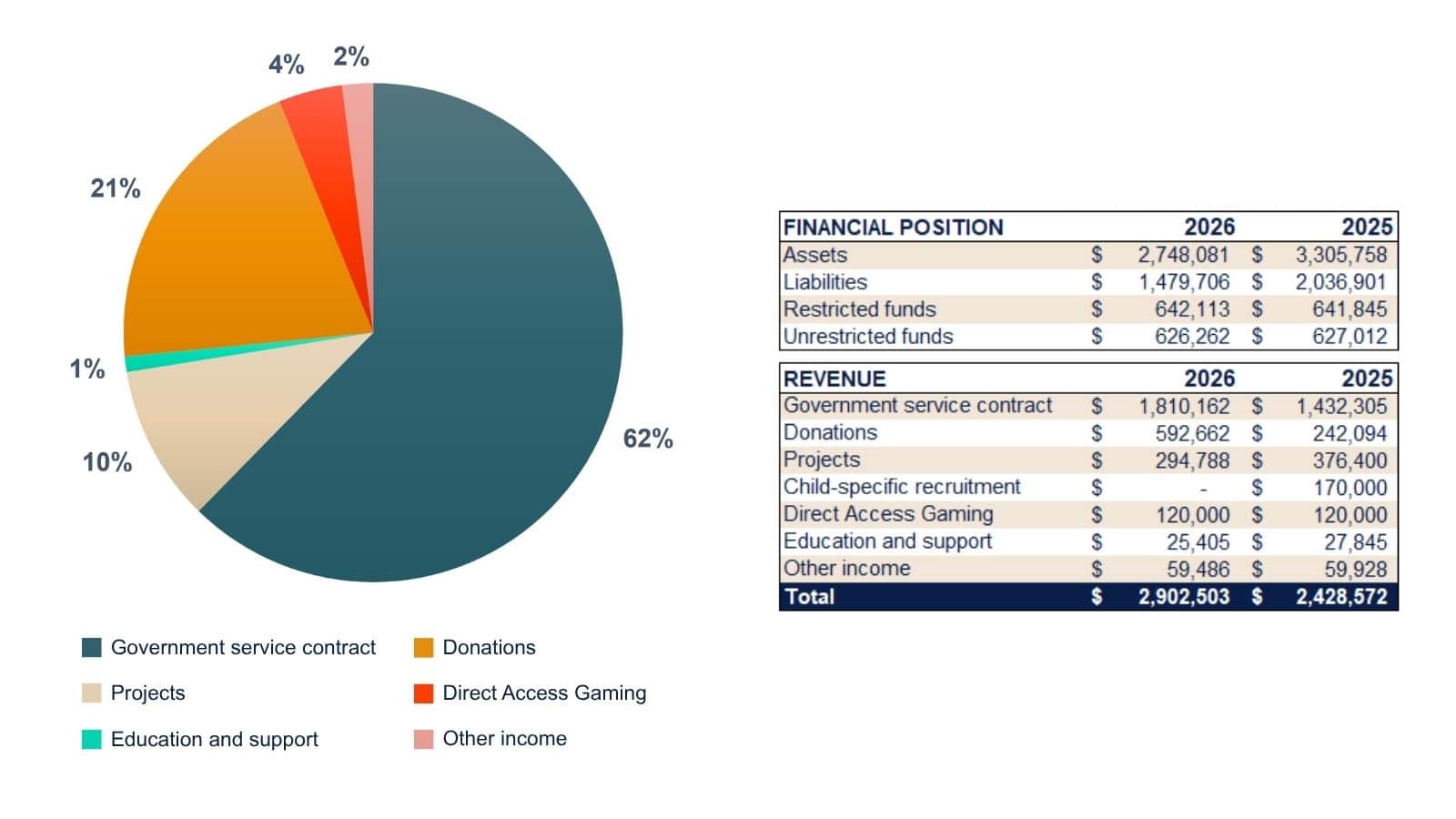
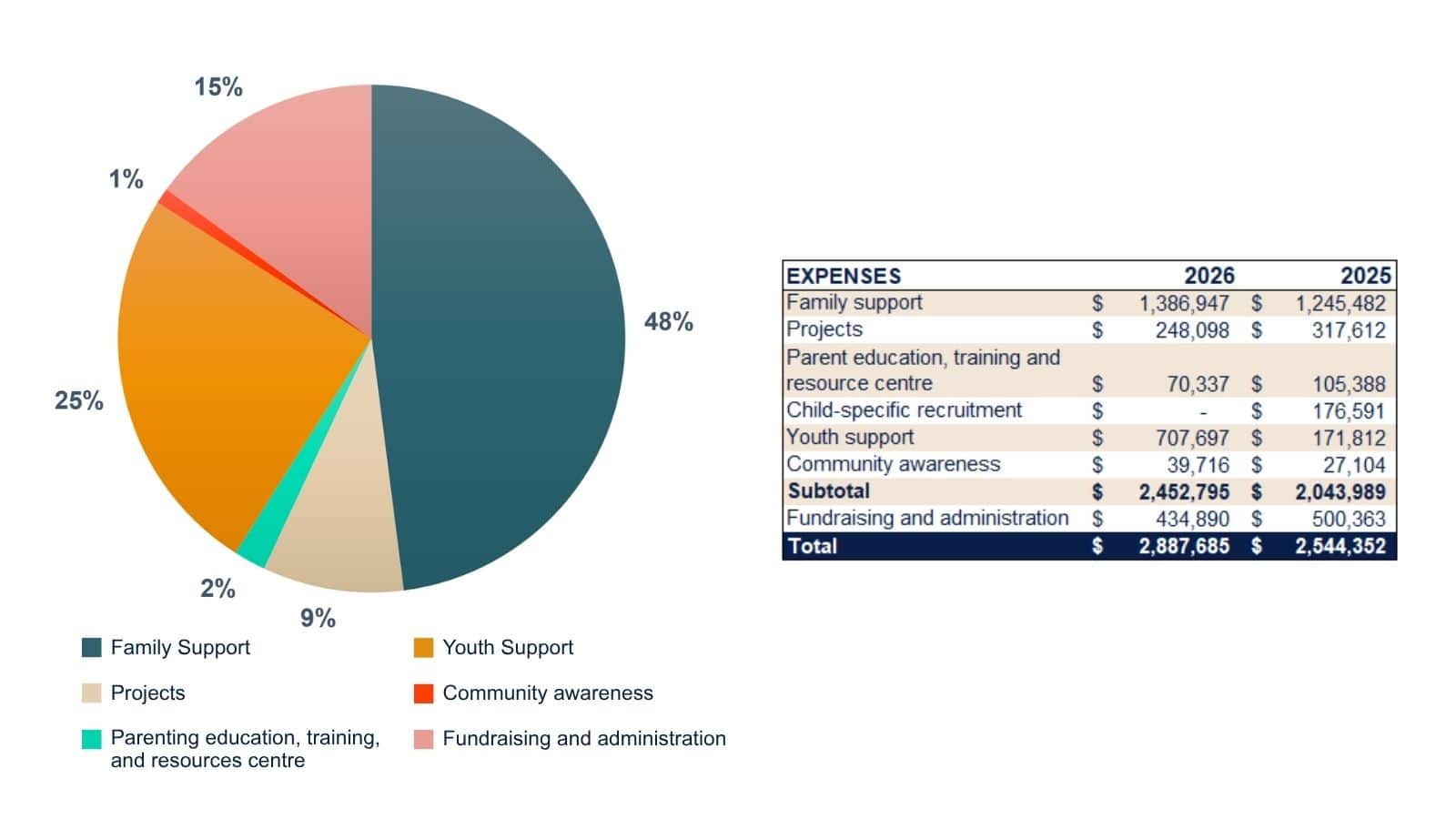
Financials

Financial Data Graphic

Revenue

Financial Data Graphic

Expenses

Indigenous relations

Our commitment to truth and reconciliation is ongoing and continues to shape how we develop our programs, resources, and services.

Indigenous Knowledge Keepers helped guide the updated LEAP curriculum from the beginning of its redesign. Their guidance helped weave Indigenous perspectives and content throughout the curriculum, including the importance of family, community, culture, identity, and belonging for Indigenous children and youth.

Indigenous members of our Youth Advisory Committee also informed our work on gender-based violence, career planning, and AgedOut.com Their lived experience helped us consider how Indigenous youth across BC might find and use these resources.

We continue to build relationships with Indigenous organizations and young people through AgedOut.com outreach and events such as Gathering our Voices. These growing relationships, and our longstanding partnership with Indigenous Perspectives Society, help us recognize where our work needs to change and guide us in making our resources more relevant and accessible.

Thank you

The Belonging Network would like to acknowledge all the individuals and organizations who gave financial gifts this past fiscal year. We are extremely grateful for your generosity and support. 

A special thank you to our Board of Directors for their gifts of time, expertise, encouragement, and for their generous financial support. We are proud that every member of our Board is a donor.

Donors

  • Adoption & Permanency Fund at Victoria Foundation
  • Dave Thomas Foundation for Adoption
  • May and Stanley Smith Charitable Trust
  • Seedlings Foundation
  • The Walsh Foundation
  • Al Roadburg Foundation
  • Diamond Foundation
  • Mark Tower
  • Vancouver Film Studios Ltd
  • Abundance Canada
  • Adrienne Murphy
  • Amory Wong
  • Anne Tower
  • Anonymous (2)
  • Bob Armstrong
  • Chris Roy
  • Face the World Foundation
  • Hamber Foundation
  • Harold Schellekens
  • Jennifer Randall Nelson
  • Merel Veldhuis
  • Monica J Rogers
  • Patrick Klassen
  • Provincial Employees Community Services Fund
  • Roblox
  • Serena’s Pizzeria
  • Shane Sauer
  • Toast.org
  • Trisha M Gagnon
  • Amur Financial Group
  • Daniel Logan
  • Gordon Richter
  • Jasbant McGarvie
  • Jennifer Rajala
  • Jimmy Bejar
  • Kali Gehringer
  • Kathleen Landry
  • Kim Boivin-Sonolet
  • Mark & Tania Bailey
  • Michelle Wootton
  • Tina Fischer
  • Treena Innes
  • Alexandra Kruthaup-Harper
  • Brianna Brash-Nyberg
  • Helen Lamb
  • Maria Angela Muhr
  • Mary Francisco
  • Mona Brash
  • Nadjy Nackna
  • Salesforce
  • Sophia Tanaka
  • Tracey Boulton
  • Golf for Good 2026
  • Linde Equity
  • Louis Family Foundation
  • Peggy Howard
  • Peter & Joanne Brown Foundation
  • Randall Foundation
  • TELUS
  • Special thank you to Tracey McVicar for her ongoing support for the BC Orca Bursary Program

Board Members

  • Chris Roy, Chair
  • Kathleen Landry, Vice Chair
  • Beatriz Metzner, Secretary Treasurer
  • Jennifer Randall Nelson, Director-at-large
  • Logan Broeckaert, Director-at-large
  • Tracey Welsford, Director-at-large

Give the gift of belonging

Donate today to help us find caring families for waiting children, support foster youth as they transition to adulthood, and give adoptive and permanency families a place to turn to for support and connection during their unique and challenging journeys.